
Finding Barnstable Residents Through Records
Barnstable has no official list of every person in town. The useful public trail is divided by purpose. The assessor identifies a parcel and its assessed owner. The Registry of Deeds identifies parties to property instruments. The state voter page checks one person’s registration status, while a municipal voter-list request goes through the Town Clerk. Courts, vital records, and historical collections each answer narrower questions.
Start with a name, an address, or a date, then keep the source type attached to the result. An owner listed on a tax record is not necessarily an occupant. A deed party is not necessarily a current resident. A historical directory entry proves a dated appearance, not a continuous connection. That distinction makes a Barnstable residents directory useful without turning public fragments into a profile.
- For a current address, search the Town of Barnstable assessor by street, owner surname, or map and parcel key.
- Open the linked GIS map to confirm the parcel, village label, and nearby physical features.
- Use the Registry name index, book and page, or instrument search to document the title trail.
- For one voter’s status, use the state form with the required identifying fields. Request a municipal list from the clerk only when a specific public list is needed.
- For a past household, move to the Sturgis Library and State Library directory, newspaper, census, and voting-list collections.
Barnstable Records Need a Place Check
The municipality is the Town of Barnstable, a city-form municipality in Barnstable County. Barnstable Village, Centerville, Cotuit, Hyannis, Marstons Mills, Osterville, and West Barnstable are core town villages. Postal communities add names such as Craigville, Cummaquid, Hyannis Port, Santuit, West Hyannis Port, and Wianno. Those names matter when a record is searched or compared.
A county Registry search can also return records from all fifteen Barnstable County towns. A postal city or ZIP can differ from the municipal-town field. Record the town, village or community, postal city, ZIP, and parcel identifier separately before deciding two hits describe the same place.
- Parcel
- A map-based property identifier used by the assessor and GIS, often the most reliable bridge between an address and a map.
- Index
- A finding list that points to a record. It is not always the full document or an official copy.
- Resident roll
- A record created for a limited public purpose, such as assessment or registration, rather than a complete household census.
- Postal city
- The delivery name attached to an address. It may not match the municipal town or village.
Barnstable Offices Behind Resident Records
Each custodian keeps a different part of the Barnstable record trail. The Registry holds title instruments for the county. Town Assessing maintains the property display and map connection. The Town Clerk handles local elections, certificates, archives, and municipal public-record routing. Ask the office for a defined record and date range instead of requesting everything about a person.
Barnstable County Registry of Deeds
3195 Main Street / Route 6A
Barnstable, MA 02630
Public access: Monday through Friday, 8:00 AM to 4:00 PM
Town of Barnstable Assessing
Municipal property values and parcel details
Use the map, owner, or street search routes.
Barnstable Town Clerk
367 Main Street, Hyannis, MA 02601
508-862-4044
Monday through Friday, 8:30 AM to 4:30 PM
Barnstable Property Search Fields
The Town of Barnstable Assessing portal has three practical entry points: map, block and lot; owner last name; and street number with street name. Full or partial values are accepted. Its results distinguish Parcel, Location, Owner, Details, and Map, which helps separate a name hit from the property record that supports it.
| Portal route | Useful input | Result to preserve | Limit |
|---|---|---|---|
| Owner search | Full or partial last name | Parcel and location | Common surnames need a second identifier |
| Street search | Street number and street name | Result list, Details, Map | One street can span several result pages |
| Map/Block/Lot | Parcel key | Property detail and map link | Formatting may vary between systems |
| Detail display | Selected property | Owner-as-of date, village, values, sale references | Assessment is not a title opinion |
The official assessor search illustrates the three search panels used to begin a parcel trail.
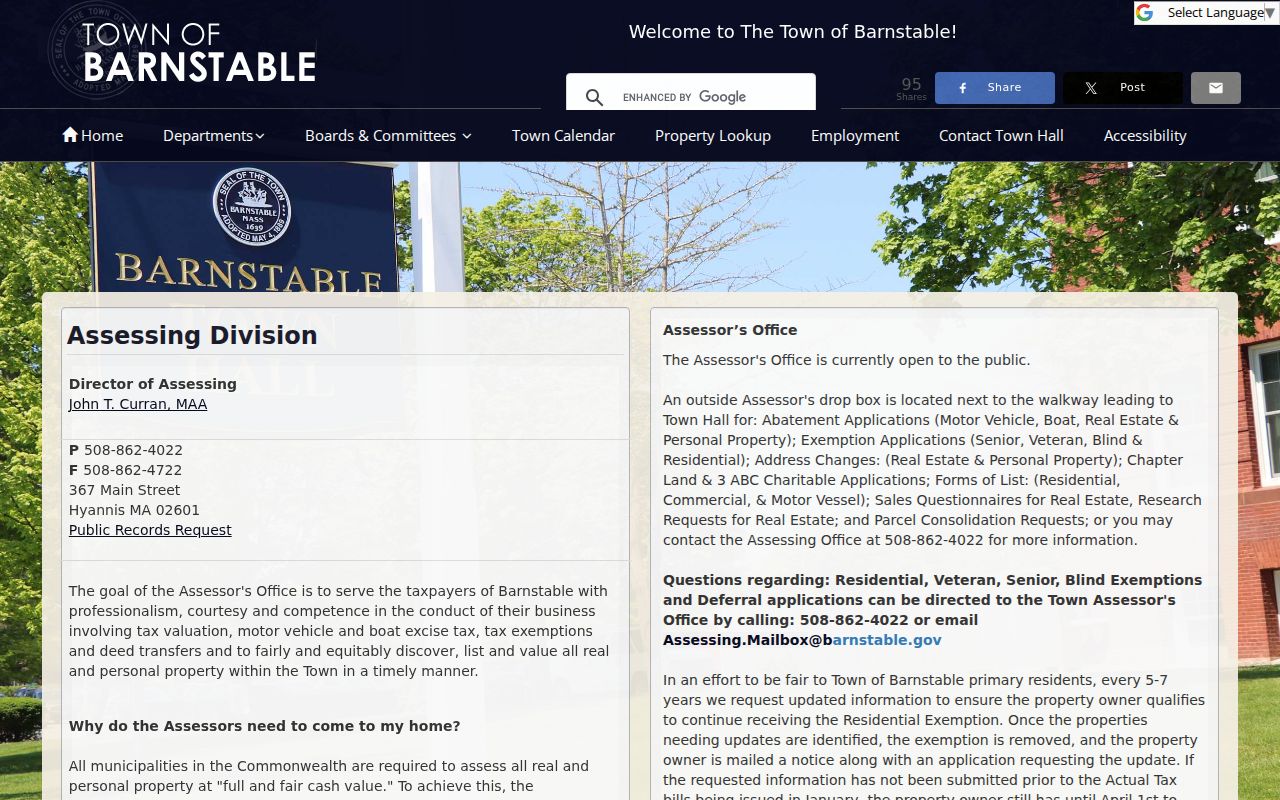
Use the Details and Map links as a bridge to later property and title checks, not as proof of household occupancy.
Barnstable Deed Records Across Three Eras
Barnstable County’s Registry is a particularly deep property source. Registry property records begin in 1742, Land Court records begin in 1898, and the address index begins only in August 1993. Those dates explain why an older house cannot be researched by a modern street query alone. Use a party name, book and page, instrument, plan, or prior deed reference for earlier links.
The Registry’s public index and images are free to view. Its online image carries a notice that it is not an official copy. A clean printed copy goes through the print-cart process and is listed at one dollar per page plus the stated card convenience charge. The property instrument can document title history, mortgages, releases, plans, or restrictions, but it does not by itself show who is living there.
The Registry’s official home page sets out the countywide title-record scope and historic coverage.
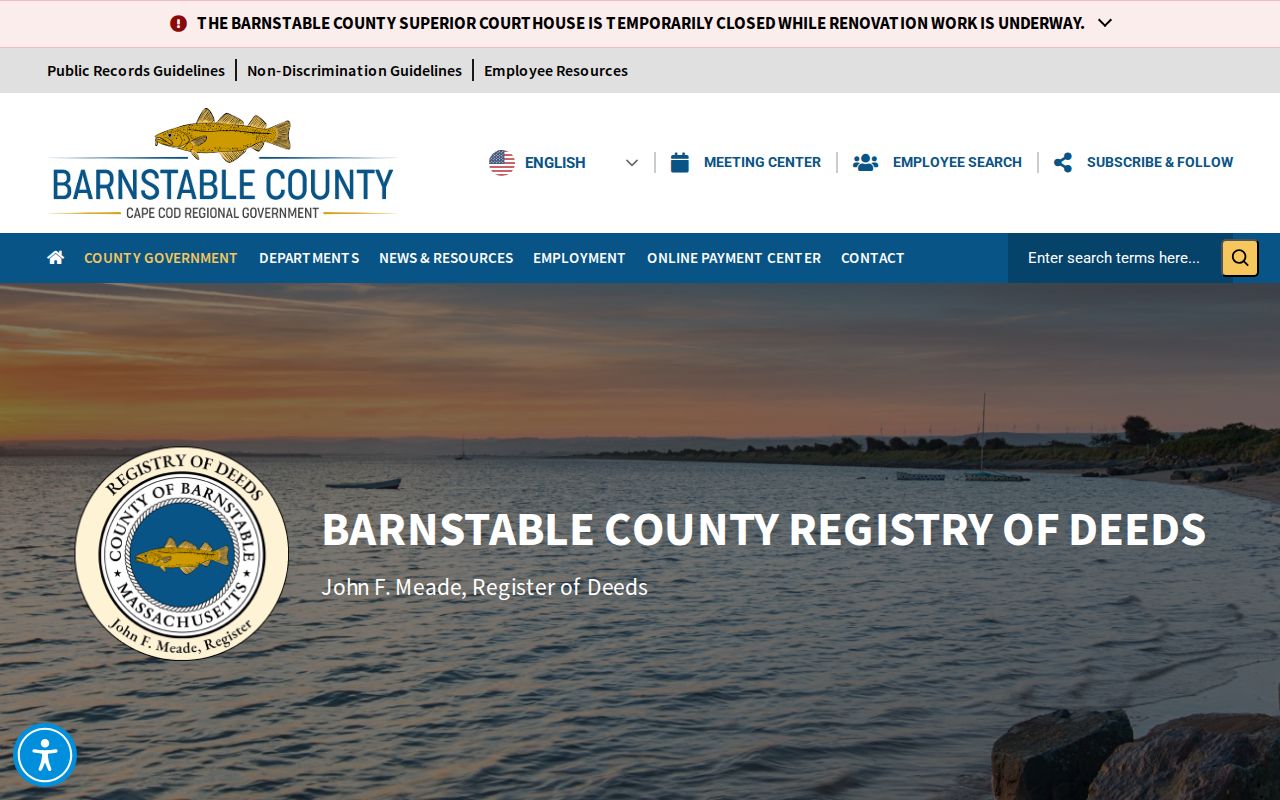
Choose the town filter carefully, because a countywide result can include a record from another Cape Cod town.
Current Barnstable Resident Record Sources
Current public sources are purpose-built. They should be compared, not blended. The assessor gives a property association; the Registry gives parties to title documents; the voter-status tool confirms a single registration-status query; and a court docket reports a case record. For a name-centered source chain, the Barnstable resident lookup explains how to keep those roles separate.
| Source | What it can establish | Custodian | Access boundary |
|---|---|---|---|
| Assessor property detail | Parcel, assessed owner, location, sales reference | Town of Barnstable | Owner field is not occupancy proof |
| Registry index | Parties, instrument, recording data, plans | Barnstable County Registry | Countywide title record, not a resident list |
| Voter status | One individual’s registration status | Massachusetts elections | Requires first name, last name, date of birth, and ZIP |
| Municipal voter list | Fields permitted in a requested local list | Town Clerk | Some fields and confidential records are not public |
| Court eAccess | Docket index and case metadata | Massachusetts Trial Court | Not the official file; restricted matters are excluded |
Barnstable Voter Status Is Not a Roll
Massachusetts provides an individual voter-status lookup, not an open statewide table of names. The form asks for first name, last name, date of birth, and a five-digit residential ZIP. A Barnstable voter-list request belongs with the Town Clerk or election office, with the municipality, ward or precinct, year, and desired format identified.
Public local-list fields can include a name, address, party, date of birth, active or inactive status, and voter ID in the applicable record. Phone, email, veteran status, permanent absentee information, confidential records, and certain minor or pre-registration fields are protected. A registration address is not proof of occupancy or a measure of personal conduct.
The Massachusetts voter-status page shows the individual-only fields and agreement step.
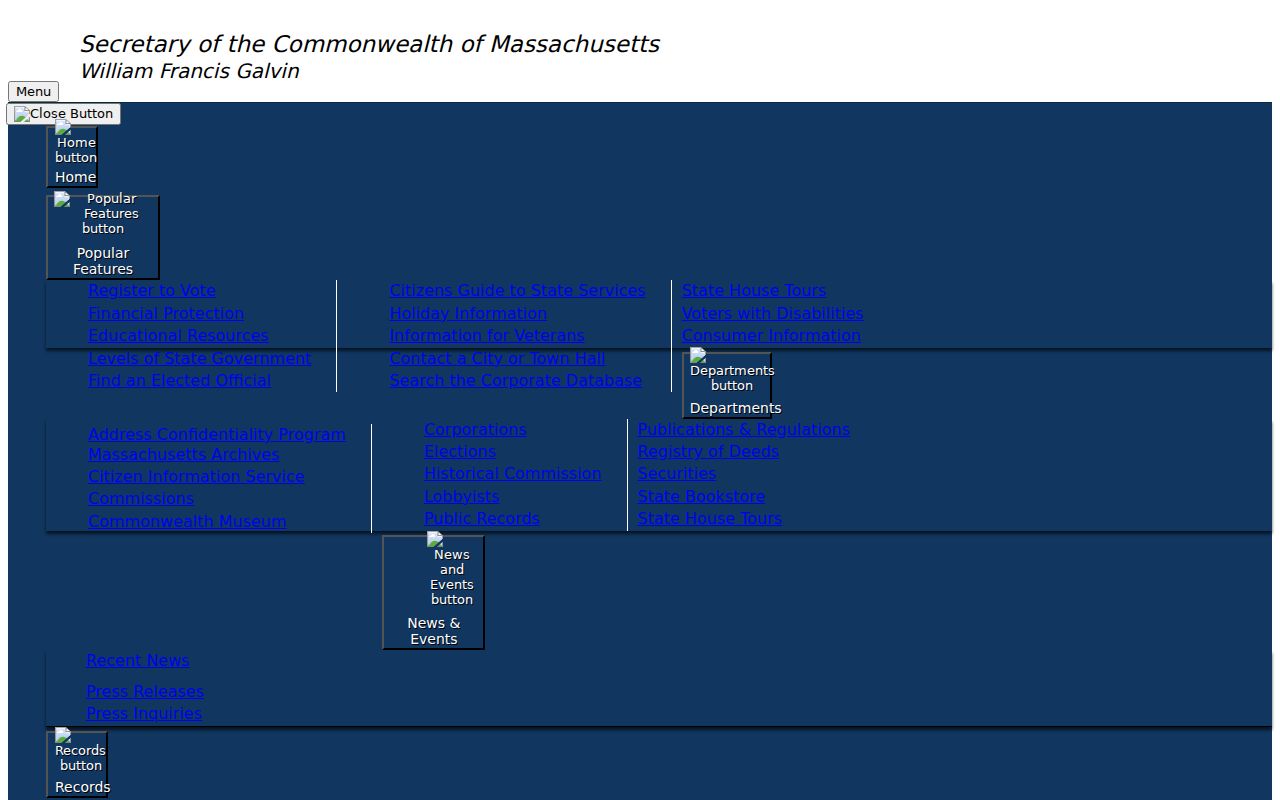
For historical voter snapshots, use the listed State Library holdings rather than treating the current form as a historical directory.
Barnstable Names in Courts and Vital Records
Massachusetts Trial Court eAccess offers Name, Case Type, Case Number, and Ticket or Citation tabs. Department, division, and location are core filters. A result can show a party or company, case number, type, file date, action, status, and court. It is a docket index, not the official court file, and it may not include the most recent activity.
Barnstable Probate and Family Court serves the county for estates, guardianships, conservatorships, family matters, and related filings. Some categories are confidential or impounded. For family history, a probate result is a lead to verify with the register or clerk rather than a conclusion about a person.
Vital records take a different path. The Town Clerk holds local material, while the Registry of Vital Records and Statistics holds statewide records from 1936 forward. Genealogy access is generally planned around 90 years for births and marriages and 50 years for deaths, subject to current eligibility, authorization, exemptions, and court-order rules.
Barnstable Public Record Requests
When no online index exists, a narrow request is more useful than a request for a person’s full history. Name the record type, department, date range, and preferred format. Useful examples include a dated municipal record, an election list for a stated year, a defined permit record, or an archive item. The Records Access Officer can tell a requester whether the office holds the record, needs more time, must charge a fee, or must withhold material under an exemption.
Massachusetts Public Records Law, MGL c.66 §10 together with MGL c.4 §7, provides the framework. Any person may make a request, and a written request is important when appeal rights matter. The general response framework is ten business days, with lawful extensions and exemptions. It does not override court impoundment, vital-record eligibility, or confidential voter rules.
The Secretary of the Commonwealth request guidance summarizes the statewide process.
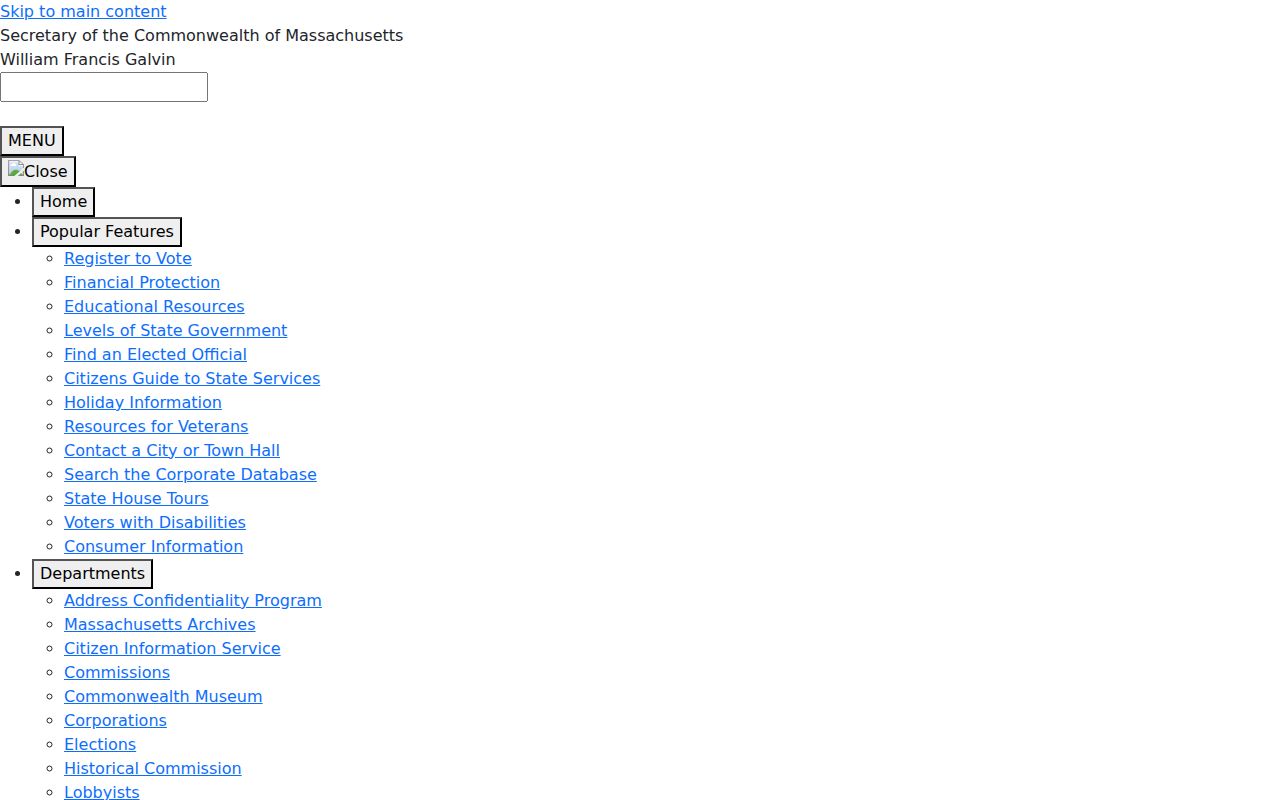
A precise request protects both the requester and the custodian from a vague search for personal information.
Historical Barnstable Resident Directories
For a dated household question, Sturgis Library is the strongest local starting point. Its Barnstable Patriot digital archive spans 1830 through 2017, and the Barnstable Register archive spans 1836 through 2017. The library also describes print and microfilm research, family and civic collections, cemetery material, early deeds, and its handwritten Cape census collection. An index hit needs the article image and date checked before it is treated as evidence.
The Massachusetts State Library specifically lists Barnstable and Hyannis directory years 1895, 1901, and 1926. It also lists Barnstable voting-list years 1924, 1943 through 1959, 1966, 1967, 1980, and 1988. Those are snapshots. They can place a person or business in a particular year, but they do not establish an uninterrupted address history.
Barnstable’s Sturgis Historical Shelf
Sturgis Library at 3090 Main Street in Barnstable is a regional research center for Cape history, genealogy, and maritime history. Its finding aids describe more than 2,000 early Cape deeds beginning in the 1620s, alongside family papers, diaries, cemetery records, maps, church material, organizations, and local photographs. These are repository collections, not a searchable current-person database.
MS.134 holds three boxes of original handwritten census records for most Cape towns, principally for 1850, 1860, 1870, and 1880, including a Barnstable 1870 folder. The collection is incomplete, so a missing name does not settle the question. Preserve the repository, collection name, folder, page, year, and whether the evidence is an index or an original image.
Barnstable Official Sources and Compiled Listings
Official sources begin with a stated custodian, record purpose, and access rule. A Town assessor detail identifies an assessed owner as of a date. A Registry image identifies the parties and recording data for one instrument. A court portal supplies a docket index with its own disclaimer. Each source can be checked at the office that maintains it, and each has a clear limit.
Commercial people-finding services are a different category. They may combine public and nonpublic data, charge for a result, and present a name or address without showing the original custodian or date. A result from that category is not a substitute for a parcel record, a certified copy, or a dated library item. Use an official source to verify a record that matters, and use its correction or safety process when appropriate.
For Barnstable research, the best comparison is not which result has the most fields. It is whether the result answers the specific question, identifies its date, and can be traced to the government office or repository that created it. This approach reduces mistaken matches and avoids turning a historic or property record into a claim about current household composition.
Barnstable Record Freshness Checks
Portal availability and data vintages change. The Registry’s recording-statistics category showed a July 2026 report posted August 6, 2026 when the research was inspected. MassGIS reported an update to its property-tax-parcel page on July 22, 2026, part of a statewide standardization effort. These are operational cues, not resident lists, but they are useful reminders to check a source date before relying on a map or export.
Sturgis Library’s newspaper page stated that the Barnstable Patriot and Register digital archive was back online and gave a current hobby-account instruction when reviewed on August 25, 2026. The research did not locate a dated restoration announcement, so that status should be treated as current when inspected rather than permanent. County pages also referenced a temporary Superior Courthouse closure during renovation, without a captured reopening date. Confirm current court operations with the court before a visit or request.
Barnstable Record Privacy Boundaries
Public records are not a license to republish every available field. Massachusetts law works alongside agency exemptions, court impoundment, voter confidentiality, and vital-record eligibility. The Address Confidentiality Program can provide a substitute address and mail forwarding for eligible people facing address-disclosure danger. Court Rule 1:20 also has a protected-address process for court participants.
Lawful use. Use Barnstable record sources for personal, civic, family-history, estate, or property research. Do not use them to stalk, harass, intimidate, or harm another person, and do not publish protected-address or sensitive identifying data.
A name match must be verified with independent details, a source date, and the custodian’s own access rules. When a record is wrong, contact the office that created or maintains it.